Cut the cloud bill, escape the lock-in, and run lean infrastructure you actually own. Senior engineering judgment — then we hand it back to your team. USD-billed for global teams.
A bill that climbs every quarter usually isn't a usage problem — it's a complexity-and-lock-in problem. We fix the root cause, not the dashboard.
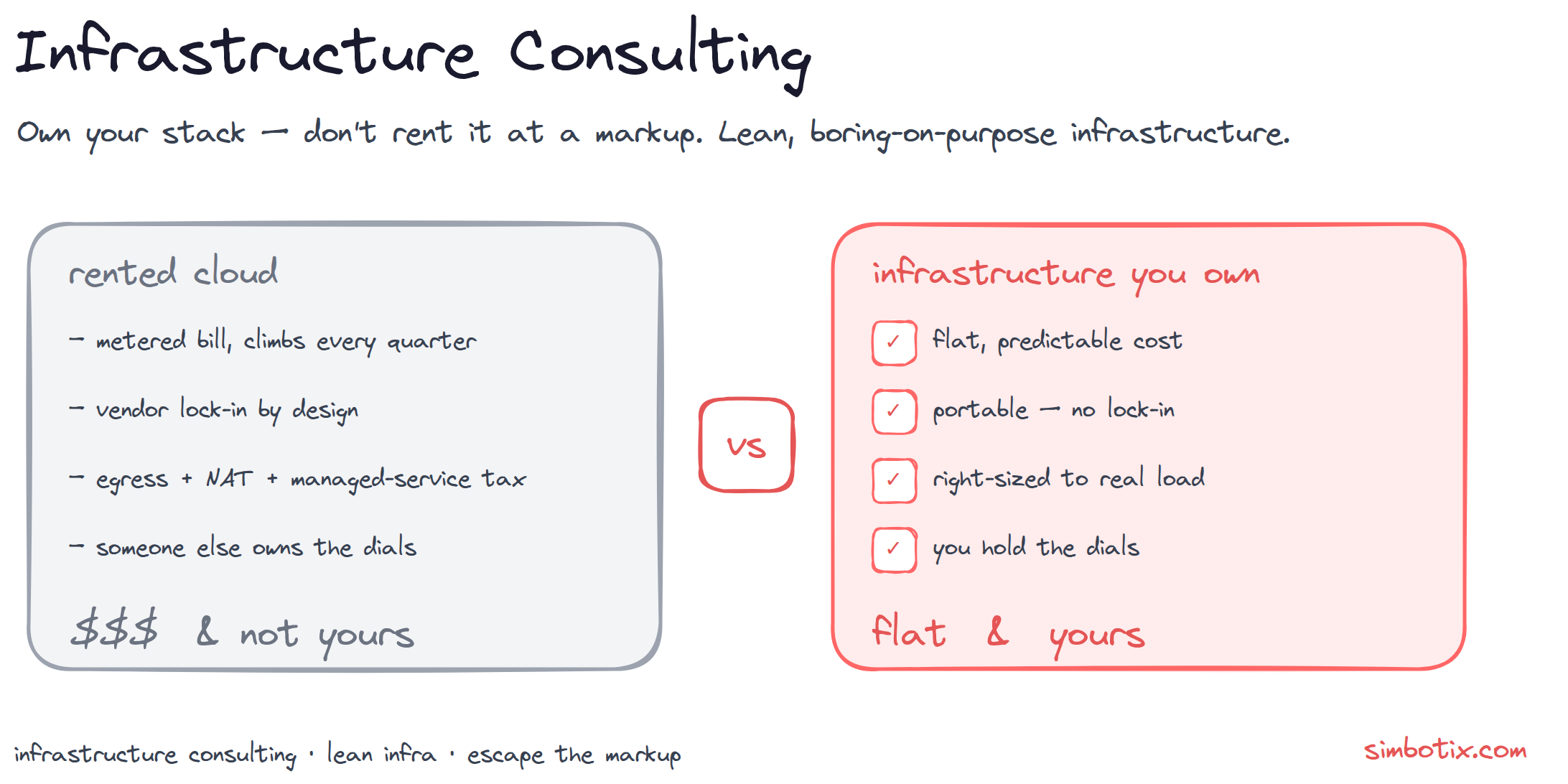
Assess, simplify, right-size, and hand back — a stack your team owns, not a dependency on us.
Map your stack and your bill end to end, then name the waste, the risk, and the lock-in. You get the findings whether or not you hire us further.
Capacity matched to real load, not a launch-day guess. The single biggest source of overspend on almost every account.
Fewer moving parts. Half of an infrastructure bill is complexity nobody needs — we remove it before we optimise what's left.
Portable infrastructure on hardware you control. No lock-in by design — you can leave us, and your stack, anytime.
You can see the system AND the bill. Cost becomes a metric you track like any product number, not a black box.
We leave runbooks and your team owning the result. The goal is independence, not a permanent dependency on us.
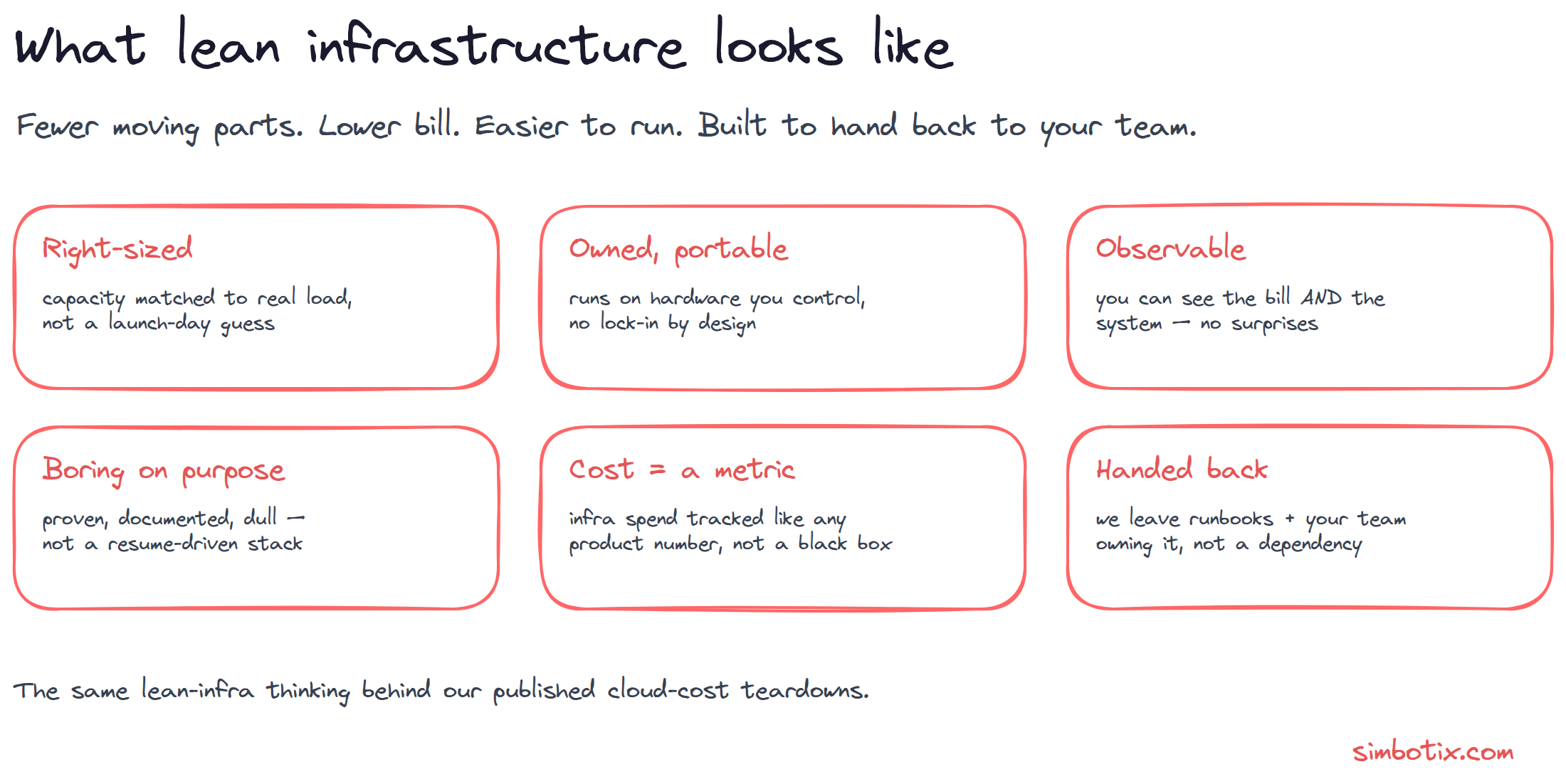
This is the same lean-infrastructure thinking behind our published work — what lean infrastructure actually means, building a private cloud on bare metal, treating the infra bill as a product metric, and how one team cut $120K/month. Real systems, public numbers.
We're not for everyone, and pretending otherwise wastes your time.
The questions everyone asks before they hire.
An infrastructure consultant assesses how your systems run and what they cost, then right-sizes, simplifies, and de-risks them — cutting waste and lock-in while improving reliability. The output is a leaner, cheaper, more portable stack, plus the runbooks for your team to own it.
Lean infrastructure means fewer moving parts, capacity matched to real load, no vendor lock-in, and cost tracked as a first-class metric. It's deliberately boring and well-documented — optimised to run reliably and cheaply, not to look impressive on a slide.
Engagements start with a fixed-scope assessment, then optional implementation on a retainer. All quoted in USD. The assessment is sized so it pays for itself in the savings and risk it surfaces — if it won't, we'll tell you before you commit.
Yes. We work with teams across the US, UK, Australia, Singapore and the UAE. Engagements are remote-first and billed in USD.
No — that's the opposite of the goal. We hand back runbooks and a stack your own team can run. If you can't operate it without us, we haven't finished the job.
Tell us how your infrastructure runs and what it costs, and we'll point at the biggest waste, risk, and lock-in on the call — no obligation. If a full engagement makes sense, we'll scope it; if it won't pay for itself, we'll say so.