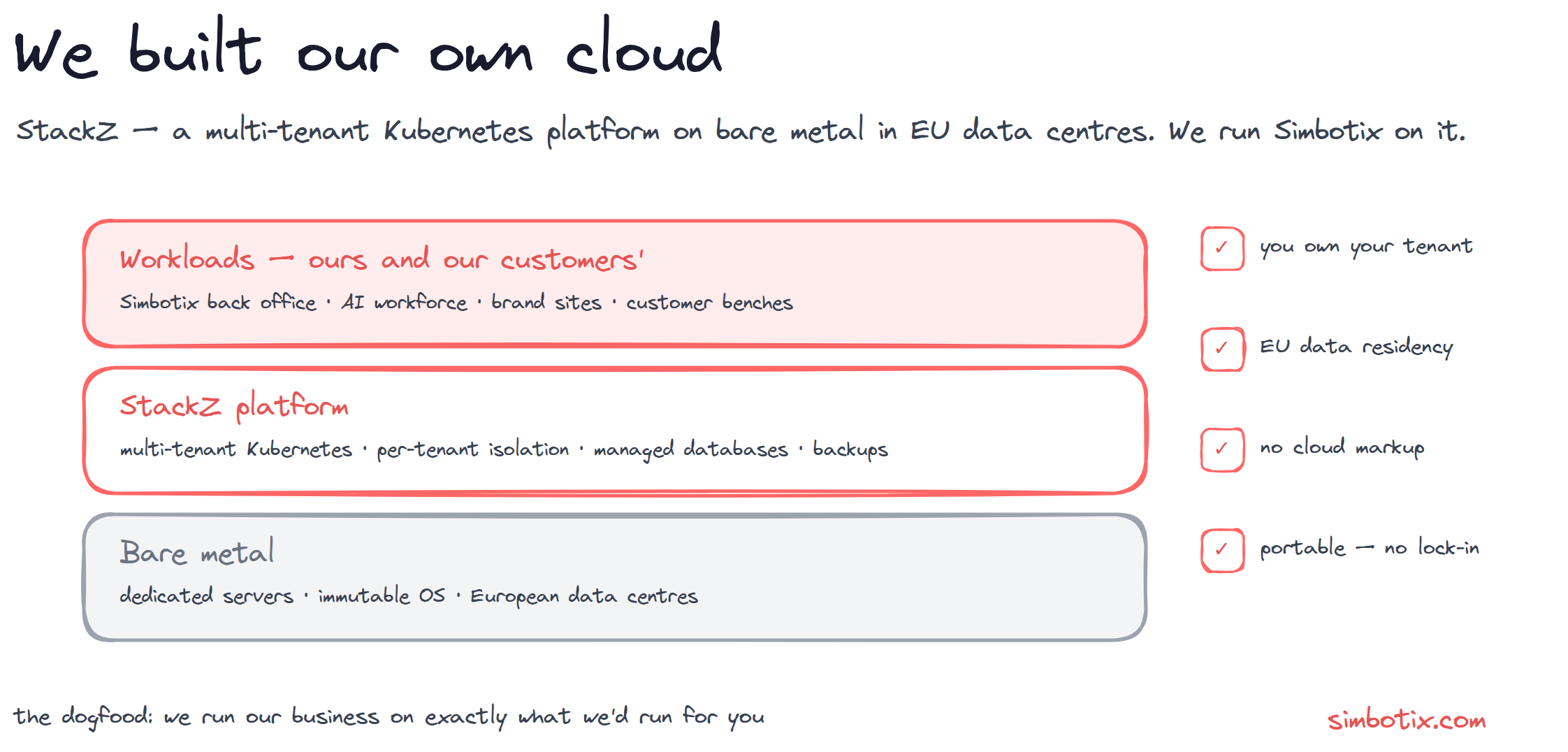
StackZ is our own multi-tenant Kubernetes platform, on bare-metal servers in European data centres. We run the entire business on it — and it's the same platform we'd run your back office on.
The one piece of proof a new practice can show without anyone's permission: what we run for ourselves.
The deep technical version — why we did it, what it actually costs, and the situations where you absolutely should not do the same — is written up in full here: building my own cloud.
Not because the cloud is bad — it's genuinely good — but because the cloud's roadmap is the cloud's, not yours.
The cloud will sell you almost everything except one thing: control over your own roadmap. It decides which APIs deprecate, what your egress costs, and whether the monitoring vendor on top of it can charge you eight times what the same software costs to run yourself. Most of the time none of that matters — until a pricing change, an acquisition, or a regulation makes it matter.
So we built StackZ: dedicated servers, an immutable OS, and a multi-tenant Kubernetes platform from the metal up. Every workload sits in an isolated tenant. Data stays in European data centres by construction. The cost is flat and predictable, not metered. We own the dials.
The honest caveat — and we lead with it: if you're racing a product to customers, you should use the cloud, not build this. Running your own substrate spends the one resource a young company can't spare: time. We did it because infrastructure is our product. You shouldn't — which is exactly why renting a tenant on ours, instead of building your own, is the sensible version of this idea.
Not a slide. What our business actually runs on, in production, every day.
The whole company runs on ERPNext here — accounting, CRM, payments. If the platform falls over, our own business stops. That keeps us honest about it.
The automation agents that run parts of the business live on the platform as durable, long-running workloads.
simbotix.com and the four studio brands are all served from the same substrate.
Each tenant gets its own namespace — its own data, backups, and performance envelope. No multi-tenant compromise. This is the pattern we'd run your back office on.
Postgres, MariaDB, Redis, ClickHouse — provisioned, replicated, and backed up on the platform, not rented from a separate vendor.
Automated and tested — the part everyone skips until it bites. We run it because we can't afford to lose our own data either.
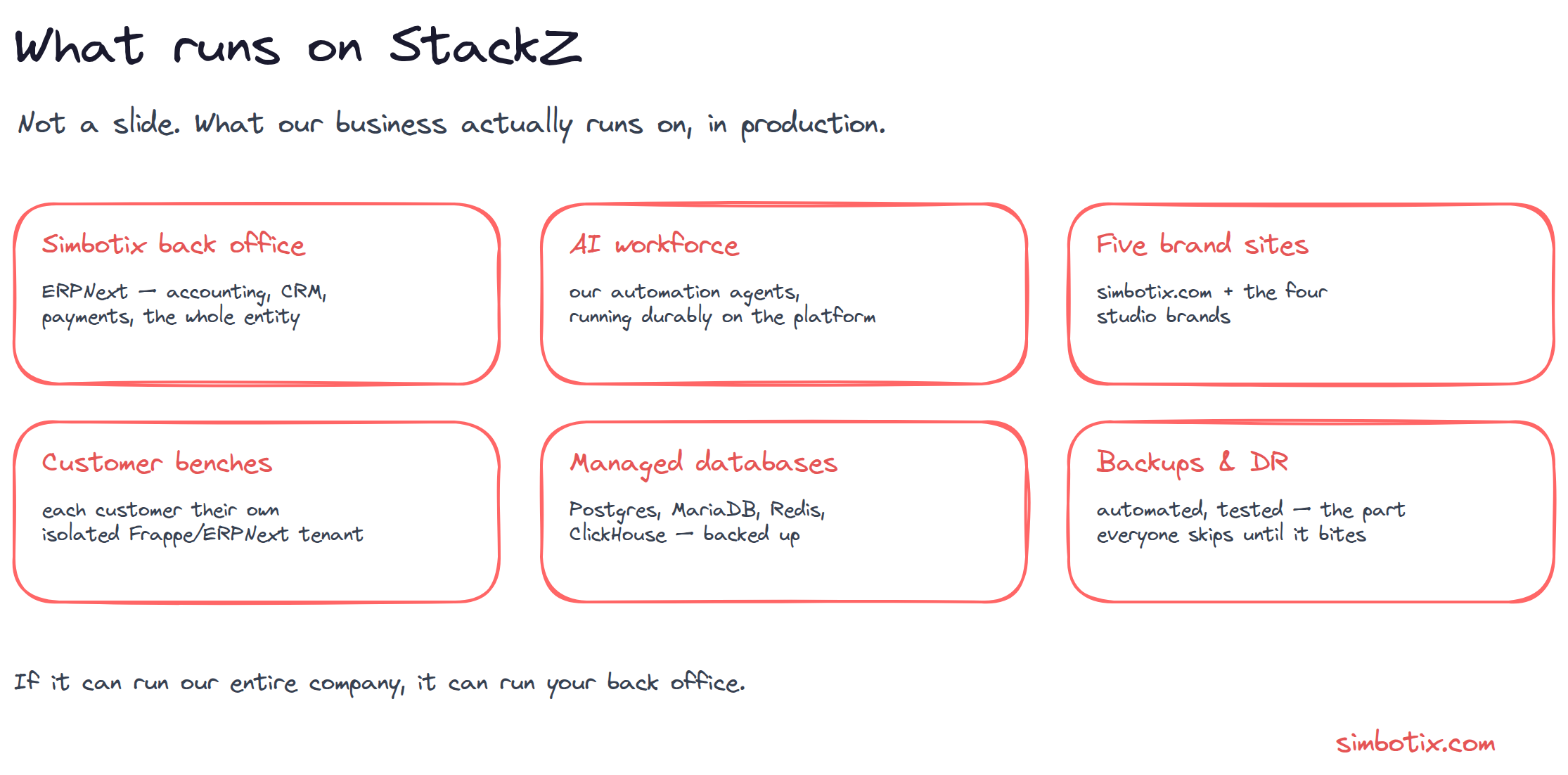
We dogfood the whole thing. If StackZ can run our entire company — books, brands, automation, and all — it can run your back office on a dedicated, isolated tenant you own.
Want your back office on a dedicated, isolated tenant — your data, your backups, EU residency, no multi-tenant compromise? Or want the same lean-infrastructure thinking applied to the stack you already have? Let's talk.